MIPA (Miniature Ion Precipitation Analyser)
MIPA (Miniature Ion Precipitation Analyser) is an ion monitor sensor that measures the ion distribution function over the range of 10 eV to 13.5 keV with moderate mass resolution within a 80° x 360° (hemispherical) field-of-view. The size of the directional pixels varies from 5° x 15° to 40° x 20°. The geometrical factor of MIPA is optimised for monitoring very high fluxes (up to 10⁹ particles/cm²·s·sr). MIPA measures a single direction and energy instantaneously, with a sampling time of 7.2 ms. The full measurement cycle, covering all energy steps and directions, takes 20 seconds, including processing time.
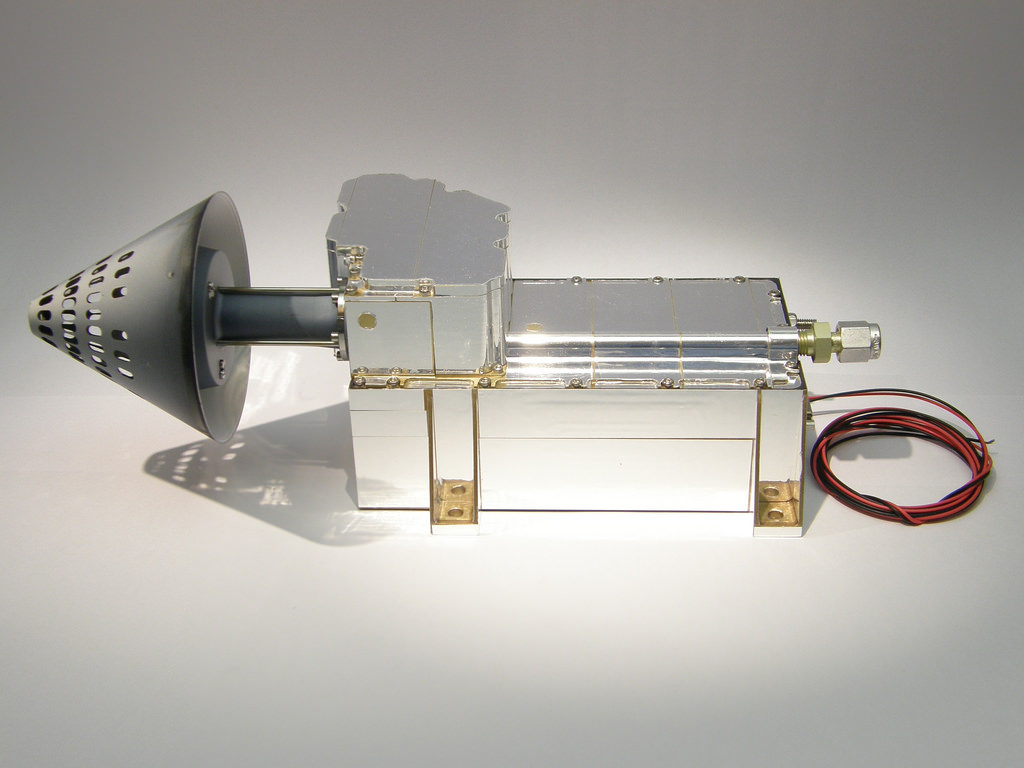
MIPA Flight Model
The ion flux arrival angle is analyzed by an electrostatic deflector, and the energy is determined by a subsequent cylindrical electrostatic analyzer. The ions exiting the energy analyzer are post-accelerated by a voltage applied to the time-of-flight (TOF) cell, which consists of START and STOP surfaces and two electron multipliers (CCEMs). The ions hit the START surface, producing secondary electrons, which are then reflected toward the STOP surface. The electrons are collected by the START CCEM, generating a START pulse. Secondary electrons from the STOP surface are collected by the STOP CCEM, generating the STOP pulse. The timing of the event provides the ion velocity, which, in combination with the known energy, determines the mass.
MIPA technological highlights
Using innovative time-of-flight technology (advanced for the year 2003), based on surface–particle interaction, MIPA mass was reduced to 610 g. The deflector for directional analysis employs a novel design consisting of three funnel-like electrodes. The ingenious approach solves the problem of the thermal trap created by the deflector geometry. It incorporates a perforated conical radiator, a titanium decoupling tube, and a unique coating, enabling the electronics to operate at moderate temperatures even when the deflector temperature reaches up to 400°C.
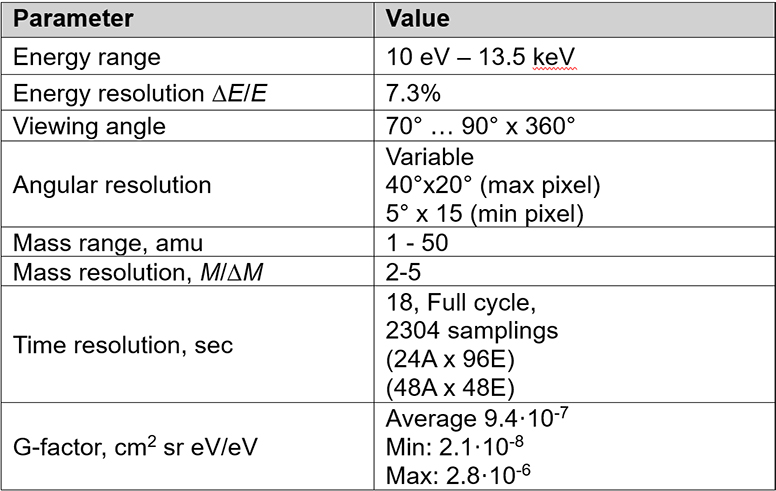
MIPA Performance table

